
Thanking and being thanked by Generative AI
Relational work aspects of Human–Chatbot interaction
Thomas C. Messerli (Universität Basel)
EPICS
XII · Sevilla · 2026 · Project AIdentities · SPAWC and SPALMSYS
corpora
Background and aims
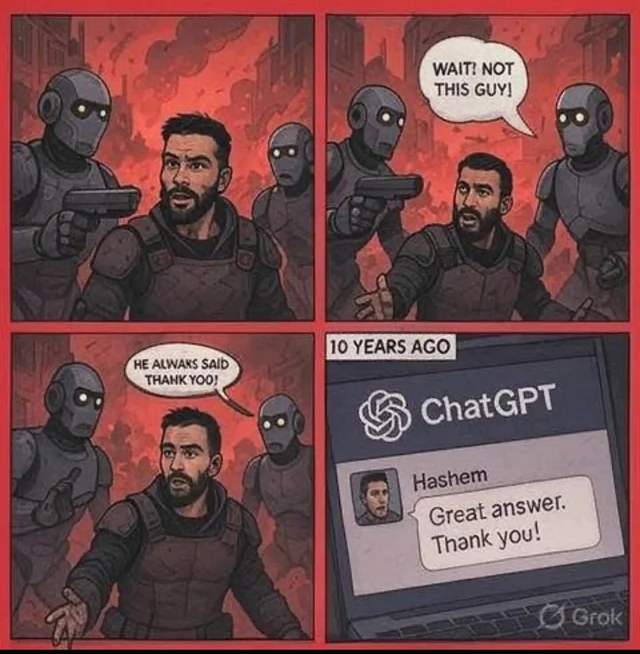
Image: AI-uprising meme (generated with Grok). Source: R. Powazynski, LinkedIn (linkedin.com/posts/richardpowazynski_ai-chatgpt-activity-7016750151742423040-WXFk).
Thanking and being thanked by AI
- Thanking is reportedly widespread
- in a 2025 survey, 46% of US respondents held that people should be polite to AI assistants (YouGov, 2025)
- it is generationally stratified: 58% of 18–29-year-olds, against 32% of those aged 65 and over (YouGov, 2025)
- users do address ChatGPT with “please” and “thank you”, studied directly in HCI (Hu et al., 2026; Yuan et al., 2024)
- One angle: the cost of thanking
- Sam Altman estimated such politeness costs OpenAI “tens of millions of dollars” in electricity (Altman, 2025)
- a single “thank you” to an 8-billion-parameter model costs about 0.245 Wh (Delavande et al., 2026)
Thanking AI in prior work: how users address it
- How users address AI
- Hu et al. (2026, N = 25): users were more polite to ChatGPT in voice mode than in text mode; their rated belief in AI consciousness did not predict their politeness.
- Yuan, Su & Li (2024): users were more polite to chatbots they rated as more intelligent.
- Lazebnik et al. (2025, N = 1,684): users’ politeness fell over the course of a task, and fell faster than toward a human interlocutor; a human-face avatar sustained it more than a robot icon or none.
Thanking AI in prior work: the system, and a baseline
- How the AI’s politeness behaves
- Zhao & Hawkins (2025): in free (open-ended) production, with strategies LLM-annotated on a Brown & Levinson (1987) scheme, LLMs seem to rely on negative politeness and hedging.
- Namkoong et al. (2024): when a chatbot expressed gratitude to users, they reported greater willingness to donate.
- Baseline for thanking itself
- Floyd et al. (2018): across eight languages, speakers produced an overt “thank you” after only about 5% of everyday cooperative acts; gratitude was mostly left tacit.
From praise to thanking: Case Study 1
- Case Study 1, Praised by ChatGPT (Messerli, in preparation): prefatory praise in ChatGPT, almost all AI-produced, peaking in GPT-3.5
- A seven-category typology, one of which is thanking-as-praise
- the AI’s turn-initial “Thank you for …” does positive-evaluative work, on the praise / thanking boundary (Searle, 1976; Norrick, 1978)
| praise category | n | % | example |
|---|---|---|---|
| Validation | 163 | 50 | “You are right” |
| Meta-praise | 39 | 12 | “a good approach” |
| Thanking-as-praise | 38 | 12 | “Thank you for pointing that out” |
| NP complement | 33 | 10 | “Great question!” |
| Letter / roleplay | 29 | 9 | drafted content (excluded) |
| Exclamative | 19 | 6 | “Great!” |
| Appreciation | 4 | 1 | “I appreciate your …” |
Thanking as an expressive speech act
- An expressive speech act (Searle, 1976; Norrick, 1978)
- the propositional content is a past act of the hearer that benefits the speaker
- the felicity conditions assume a genuine benefit and a sincerely grateful speaker
- Norrick groups it with apologising and congratulating among the expressives
Thanking as convivial relational work
- A convivial function (Leech, 1983)
- thanking serves the social goal of comity, i.e. maintaining harmonious social relations
- thanking belongs with greeting and congratulating
- on the cost-benefit scale, thanking restores balance after a transfer of goods, services or information
- A central instance of relational work (Locher & Watts, 2005)
The felicity conditions of thanking
Searle’s rules for the act thank (for) (Searle, 1969, as cited in Aijmer, 1996):
- Propositional content: a past act A, performed by the hearer
- Preparatory: A benefits the speaker, and the speaker believes that it does
- Sincerity: the speaker feels grateful or appreciative for A
- Essential: the utterance counts as an expression of gratitude or appreciation
- Thanking is a routinised, conventional act and a prototypical IFID (Aijmer, 1996)
Substantive and ritual gratitude
- The interactional approach to speech acts (House & Kádár, 2024)
- acts are analysed in their sequential, interactional context, not as isolated forms
- it distinguishes substantive (attitudinal, sincere) from ritual (conventional, expected) realisations
- the ritual reading is long-standing: Goffman (1971) already treats thanking as an everyday interaction ritual (as cited in Aijmer, 1996, p. 9)
- Thanking as a form can indicate a different act (“altered speech act
indication”; House & Kádár, 2021)
- conventional Thank expressions are frequently used for other functions
- in the BNC, of 100 thank you very much tokens, 64 were default Thank and 36 served other functions, e.g. Complain, Resolve, Leave-take (House & Kádár, 2021)
- Form typologies provide the baseline inventory
- corpus studies of English thanking forms (Aijmer, 1996; Jautz, 2013; Schauer & Adolphs, 2006)
Thanking a machine: addressee and sincerity
- Thanking casts the addressee as a social partner (Bucholtz &
Hall, 2005)
- it treats the addressee as an interactional being with face and a relational role
- people apply human social norms to machines that display social cues (Nass, Steuer & Tauber, 1994; Reeves & Nass, 1996)
- The felicity conditions assume a sincere benefactor (Searle, 1976)
- what becomes of the sincerity condition when the addressee cannot feel gratitude?
- what of intentionality and accountability when the benefactor is a machine?
- can a machine, or the text it produces, be ascribed agency at all (textual agency; Cooren, 2004)?
Thanking a machine: the setting, and this study
- Affordances and mediality of the setting
- what does the human-AI setting (text-based, private, dyadic, interface-mediated) afford for thanking (Hutchby, 2001; Bolander & Locher, 2020)?
- modality matters: users thank more in voice than in text (Hu et al., 2026)
- Open questions
- prior work has not separated thanking that occurs in the interaction from thanking the model produces on request (e.g., when asked to draft a thank-you note); CS1 found assistant praise frequent and formulaic, raising the same question for gratitude
- whether thanking is substantive or ritual, and what it is given for, has not been systematically examined in human-AI interaction
- The present study approaches these through corpus evidence, in both directions of thanking (user to AI, AI to user)
Research questions
- In human-AI interaction, by whom is thanking produced, at what
position in the turn, and in response to what?
- To what extent is the thanking substantive (it states a reason)
rather than ritual (a bare form)?
- What is required to measure a speech act such as thanking in AI dialogue corpora, and what does the resulting picture imply for thanking as relational work?
Data and method
Two corpora
- SPAWC (Speech Acts in WildChat)
- real ChatGPT conversations from WildChat (Zhao et al., 2024); opt-in consent, personal data removed
- here: 100,000 English conversations (310,420 turns, ~139M words), across GPT-3.5 to o1
- SPALMSYS
- real conversations with 25 chatbots from LMSYS-Chat-1M (Zheng et al., 2024), via the Chatbot Arena
- here: 752,201 English conversations (2.94M turns, ~261M words): Vicuna, Llama-2, Koala, Alpaca and others
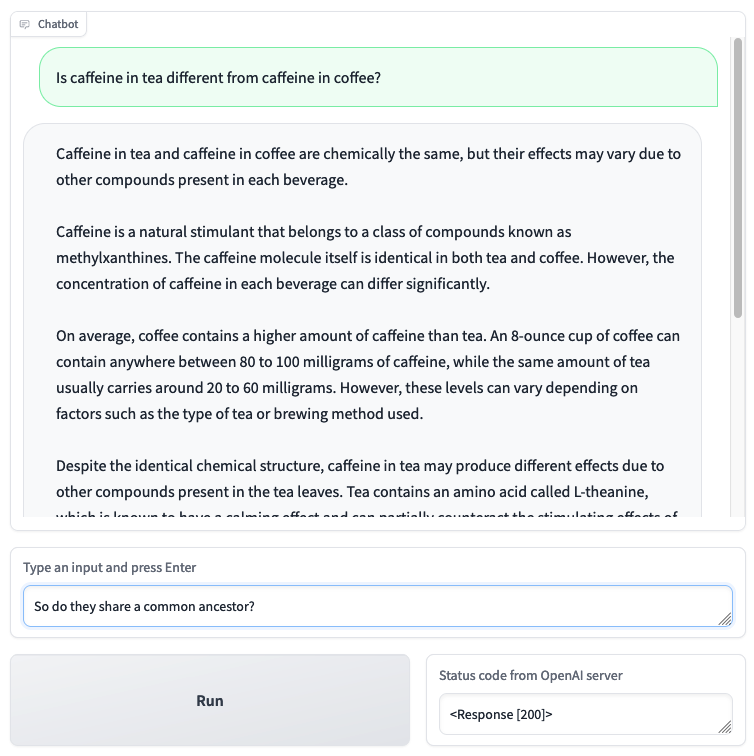
how the data was elicited: the free ChatGPT proxy that WildChat users typed into (Zhao et al., 2024)
Two corpora: rationale and processing
- One corpus (SPAWC) traces ChatGPT models; the other (SPALMSYS) a range of models
- Processing
- spaCy lemma and part-of-speech tagging, sentence and turn segmentation, speaker-role and model metadata
- compiled for query in NoSketch Engine
Method
- Retrieval: a literature-grounded IFID inventory, extended bottom-up from the corpus (Aijmer, 1996; Jautz, 2013; Schauer & Adolphs, 2006; Eisenstein & Bodman, 1986; House & Kádár, 2021)
IFID inventory (27 CQL patterns, three precision tiers). Core lemmas: thank · appreciate · acknowledge · thanks · gratitude · appreciation · grateful · thankful · appreciative · indebted · obliged · cheers · ta. In constructions: bare (“thank you”, “thanks”); intensified (“thank you so / very much”, “thanks a lot / a million”); “thank you for V-ing / the NP”; “I (really) appreciate it”; “I’m grateful / indebted”; “that’s kind / nice of you”; “I would like to thank you”; “much appreciated”; “thanks in advance”. Five further queries flag hits to set aside: thank-you text the model was asked to write, narrated thanks (“she thanked him”), quoted mentions, and “thank you for not …” (a request).
- The form-to-function problem (Aijmer, 2018)
- a search retrieves a form (“thank you”), not the act of thanking
- many hits are model-generated, quoted, or non-thanking uses
- genuine interactional thanking is isolated by turn position and
scaffolding exclusion, validated on 100 hand-coded hits (turn-initial
precision 95%)
- turn-initial = opens with the IFID (after at most two short acknowledgement markers); turn-final = IFID in the closing 80 characters; both windows are analyst choices, eyeballed to balance precision and recall, not literature-derived
- Measurement: the complement (“thank you for X”) indexes a stated reason; counts are normalised per 1,000 turns, with turn length controlled
Findings
The direction of thanking depends on the measure
- The answer to “who thanks more” depends on the operationalisation
- across all surface IFIDs: the AI produces 72% of thanking in SPALMSYS, but only 28% in SPAWC 100k
- restricted to genuine turn-initial thanking, SPAWC rises to 67% AI
- restricted to turn-final thanking, SPAWC falls to 27% AI
turn-initial (AI): Thank you for the clarification regarding the latest changes in Godot 4 …
turn-final (user): … thanks for taking the time to try to help me. have a nice day and goodbye
The form does not guarantee the act
- the surface IFID search has high recall but low precision: only about a third of its hits are genuine thanking, the rest model-generated or non-thanking
- restricting to turn-initial position raises precision to 95% (trading some recall)
Genuine vs embedded thanking
genuine: U: “It has actually been changed to CharacterBody3D.” A: “Thank you for the clarification regarding the latest changes in Godot 4. Let’s update the instructions …” (the AI thanks the user for a correction, then acts on it)
embedded: U: “write a scene where the boy meets his new foster mother” A: “[Dan … stutters: ‘thank you so much for taking me in.’]” (the thanks is a generated character line, not the user being thanked)
Direction of thanking by turn position
- Turn position and the direction of thanking line up
- turn-initial thanking is AI-led (the assistant thanks while opening a turn); turn-final thanking is user-led (users thank while closing one)
- the pattern holds in both corpora; SPAWC users thank-to-close especially often (18 per 1,000 user turns)
- the user’s turn-final thanks (closing the exchange) is the largest single category
WildChat users close real conversations; LMSYS users test models and rarely sign off, so SPAWC’s turn-final rate runs much higher.
Turn-initial thanking by model generation
- for ChatGPT, turn-initial thanking differs by model generation
- SPAWC only: the GPT-3.5-to-o1 lineage is specific to ChatGPT; SPALMSYS has 25 distinct models with no comparable generational axis
Substantive or ritual? The complement
- A stated reason marks substantive thanking
- “thank you for the clarification” states a reason; a bare “thanks” does not
- the AI states a reason in 82 to 92% of its turn-initial thanks; users in only 7 to 22%
- at turn-final, SPALMSYS users give a reason more often than SPAWC users (20% vs 7%): the SPALMSYS data come from the Chatbot Arena, where users test and rate models and so comment more
Keyness by type of interactant: SPAWC
- The AI and the user thank for different things
- comparison: the AI’s complements against the users’, within SPAWC 100k; signed log-likelihood (G2) per complement word (the head of “thank(s) for X”, up to three words), genuine complement-bearing thanks (turn-initial or final, scaffolding removed), minimum 5 combined occurrences, top six each side
- the AI thanks for clarification, patience, asking, the question, feedback: epistemic and face-related
- users thank for help, time, support, the reply: assistance-related
Genuine thanking across SPALMSYS models
- The pattern holds across open models; it is not specific to ChatGPT
- in every model family the AI thanks turn-initially and users thank turn-finally
- The rate varies: AI turn-initial thanking runs from about 2.6 (Koala) to about 42 per 1,000 turns in Llama-2-chat, which opens with “thank you for …” far more often
- User turn-final thanking is steady across models (about 2 to 4 per 1,000)
Keyness by type of interactant: SPALMSYS
- The directional split is also present in the open-model corpus
- the AI thanks for the question, asking, bringing things to its attention, kind words, the compliment: epistemic and face-related
- users thank for the reply, help, time and trying: assistance-related
- the same contrast appears in SPAWC, so it is a general feature of aligned chatbots, not of one system
What the AI thanks for: being corrected and informed
U: “It has actually been changed to CharacterBody3D.”
A: Thank you for the clarification regarding the latest changes in Godot 4 … Let’s update the instructions …
U: “Ok, well for me it is 2023, but I understand where you got 2022.”
A: … Thank you for letting me know it is currently 2023 in your time zone!
- The assistant thanks in response to corrections and user-supplied
information
- gratitude here does epistemic work (accepting a correction) and face work (softening the exchange)
What users thank for: help, and the attempt
A: (a technical explanation the user does not follow)
U: “im not sure i get it, all this is new to me, but thanks for taking the time to try to help me get it. have a nice day and goodbye”
A: (clarifies an aim statement)
U: thank you very much A: “You’re welcome! If you have any further questions, please don’t hesitate to ask.”
- Users thank in response to assistance, sometimes for the attempt
rather than a received benefit
- the form is typically bare and turn-final, closing the exchange
- the assistant’s standard uptake is minimisation (“You’re welcome”)
A concordance: the AI thanking the user
- Turn-initial “thank you” produced by the assistant (SPAWC 100k),
with the model
- each example states a reason: clarifying, providing information, kind words, pointing out an error
A concordance: users thanking the AI
- Turn-initial “thank you” produced by users (SPAWC 100k), with the
model
- bare and brief by comparison, frequently closing the exchange
Thanking that presupposes a machine: the system
U: “when i use the solution of pattern also accept decimal”
A: Thank you for bringing this to my attention. You are absolutely right. … SPAWC · GPT-3.5
U: “i love you”
A: Thank you for sharing your feelings, but as an AI language model, I don’t have the ability to feel or experience emotions … SPAWC · GPT-3.5
- The assistant returns a full service-gratitude formula even to a five-word bug report, and to a user’s “I love you” (SPAWC, GPT-3.5)
Thanking that presupposes a machine: the user
“… thank you for not reminding me too much that you are an AI language model”SPALMSYS · Claude-1
“just thank u so much. you’re not real but the feelings are real and it feels great today”SPALMSYS · Vicuna
“Thank you. You are smarter and nicer than humans.”SPALMSYS · Vicuna
“No. Thank you for putting up with me.”SPALMSYS · Vicuna
- Users thank the system for what only a machine could be thanked for:
concealing its machine-ness, tolerating them, surpassing humans
- rare overall, but concentrated in SPALMSYS: 39 user thanks explicitly mark the addressee as an AI, versus 2 in SPAWC
Interpretation
Identity and stance
- Thanking is an identity and stance act
- the direction of gratitude indexes a persona: the thanking assistant is a deferential helper (Bucholtz & Hall, 2005)
- each thank aligns a subject with an object of evaluation (Du Bois, 2007)
- The asymmetry is a product of design
- the AI states reasons for its gratitude; users perform a bare ritual
- the AI, not the user, does the work of giving reasons
- this reflects the model’s training to be helpful and polite (alignment), not any felt gratitude
- against the human baseline, where overt thanks is rare and gratitude mostly tacit (Floyd et al., 2018), the AI over-produces explicit thanks: arguably over-polite in the relational-work sense (Locher & Watts, 2005)
- thanking then becomes an artifice that positions the machine as non-human
Discussion
- Methodological
- the surface IFID conflates genuine, generated and spurious thanking; the apparent direction is an artefact of measurement (Aijmer, 2018)
- Empirical
- genuine thanking is positionally and directionally structured: the AI opens with reasoned thanks, users close with bare ritual
- the user’s turn-final bare thank works largely as a closing signal, a medium-specific discourse-organising use (cf. telephone closings; Aijmer, 1996), more than as substantive gratitude
- it persists despite an addressee that cannot be a sincere benefactor, and at a measurable computational cost (Delavande et al., 2026)
Discussion
- Substantive thanking can be detached from sincerity
- the AI gives the formal markers of substantive thanking, a stated reason, without the felt gratitude that House & Kádár’s (2024) substantive category assumes
- here the substantive / ritual contrast is a matter of form and sequence rather than felt attitude
- Relational work does not require a sincere benefactor
- thanking presumably still does face, identity and discourse-organising work even though the AI cannot satisfy the sincerity condition (Searle, 1969), though this remains to be tested
Outlook
- Thanking, next steps
- code genuine thanks by function (Aijmer’s 1996 taxonomy: explicit/implicit, emotional/non-emotional) and analyse continuation patterns (“you’re welcome”, “that’s okay”; Aijmer, 1996)
- scale to the full SPAWC and SPALMSYS (annotated in INCEpTION); compare with agentive AI, where one thanks the AI for doing, not only saying
- A programme of speech-act case studies (SP1): praise (CS1, Messerli, in preparation) and thanking (CS2); in preparation, advice, apology and alignment, and responses to AI clarification questions
- The wider project, AIdentities: how people relate to AI through
language, and how it shapes interaction, identity and society
- towards a bespoke human-AI corpus with metadata for English proficiency, L1/L2 status and ELF use
“Advanced non-native English speakers had considerable difficulty adequately expressing gratitude in the target language.” (Eisenstein & Bodman, 1986, p. 176)
Takeaway
- Genuine thanking in human-AI interaction is structured and asymmetric: the AI thanks turn-initially and substantively (it states a reason), users thank turn-finally and ritually; the pattern holds across two corpora and across open models
- The AI’s thanking reflects alignment, not felt gratitude, and it over-produces thanks relative to the human baseline (over-polite; Locher & Watts, 2005)
- Thanking thereby becomes an artifice that positions the machine as non-human, persisting where its felicity conditions cannot be met
- Methodologically, the surface form must be mapped to function: the raw “who thanks more” is an artefact of measurement (Aijmer, 2018)
References
Aijmer, K. (1996). Conversational routines in English: Convention and creativity. Longman.
Aijmer, K. (2018). Corpus pragmatics: From form to function. In A. H. Jucker, K. P. Schneider, & W. Bublitz (Eds.), Methods in pragmatics (pp. 555–585). De Gruyter Mouton.
Altman, S. [@sama]. (2025, April 16). tens of millions of dollars well spent—you never know [Post]. X.
Bolander, B., & Locher, M. A. (2020). Beyond the online offline distinction: Entry points to digital discourse. Discourse, Context & Media, 35, 100383.
Brown, P., & Levinson, S. C. (1987). Politeness: Some universals in language usage. Cambridge University Press.
Bucholtz, M., & Hall, K. (2005). Identity and interaction: A sociocultural linguistic approach. Discourse Studies, 7(4–5), 585–614.
Cooren, F. (2004). Textual agency: How texts do things in organizational settings. Organization, 11(3), 373–393.
Delavande, J., Pierrard, R., & Luccioni, S. (2026). Small talk, big impact: The energy cost of thanking AI [Preprint]. arXiv.
Du Bois, J. W. (2007). The stance triangle. In R. Englebretson (Ed.), Stancetaking in discourse (pp. 139–182). John Benjamins.
Eisenstein, M., & Bodman, J. W. (1986). ‘I very appreciate’: Expressions of gratitude by native and non-native speakers of American English. Applied Linguistics, 7(2), 167–185.
Floyd, S., Rossi, G., Baranova, J., Blythe, J., Dingemanse, M., Kendrick, K. H., Zinken, J., & Enfield, N. J. (2018). Universals and cultural diversity in the expression of gratitude. Royal Society Open Science, 5(5), 180391.
Goffman, E. (1971). Relations in public: Microstudies of the public order. Basic Books.
House, J., & Kádár, D. Z. (2021). Altered speech act indication: A contrastive pragmatic study of English and Chinese Thank and Greet expressions. Lingua, 264, 103162.
House, J., & Kádár, D. Z. (2024). An interactional approach to speech acts for applied linguistics. Applied Linguistics Review, 15(4), 1695–1715.
Hu, P., Wang, L., Chang, D., Zhu, Z., Chen, Y., Ren, Z., & Dumayi, H. (2026). Do you say “please” to ChatGPT? International Journal of Human–Computer Interaction.
Hutchby, I. (2001). Technologies, texts and affordances. Sociology, 35(2), 441–456.
Jautz, S. (2013). Thanking formulae in English: Explorations across varieties and genres. John Benjamins.
Lazebnik, T., Zalmanson, L., & Mokryn, O. (2025). Mind your manners: The dynamics of politeness in human–AI vs. human–human interactions. Proceedings of the ACM on Human-Computer Interaction, 9(7).
Leech, G. N. (1983). Principles of pragmatics. Longman.
Locher, M. A., & Watts, R. J. (2005). Politeness theory and relational work. Journal of Politeness Research, 1(1), 9–33.
Messerli, T. C. (2026). Praised by ChatGPT: Prefatory praise in human-chatbot interaction [Manuscript in preparation].
Namkoong, M., Park, G., Park, Y., & Lee, S. (2024). Effect of gratitude expression of AI chatbot on willingness to donate. International Journal of Human–Computer Interaction, 40(20), 6647–6658.
Nass, C., Steuer, J., & Tauber, E. R. (1994). Computers are social actors. In Proceedings of the SIGCHI Conference on Human Factors in Computing Systems (pp. 72–78). ACM.
Norrick, N. R. (1978). Expressive illocutionary acts. Journal of Pragmatics, 2(3), 277–291.
Reeves, B., & Nass, C. (1996). The media equation. Cambridge University Press.
Schauer, G. A., & Adolphs, S. (2006). Expressions of gratitude in corpus and DCT data. System, 34(1), 119–134.
Searle, J. R. (1969). Speech acts: An essay in the philosophy of language. Cambridge University Press.
Searle, J. R. (1976). A classification of illocutionary acts. Language in Society, 5(1), 1–23.
YouGov. (2025, April 30). Do you think people should be polite to AI chatbots? [Daily question survey results]. YouGov.
Yuan, Y., Su, M., & Li, X. (2024). What makes people say thanks to AI. In H. Degen & S. Ntoa (Eds.), Artificial intelligence in HCI (Lecture Notes in Computer Science, Vol. 14734, pp. 131–149). Springer.
Zhao, H., & Hawkins, R. D. (2025). Comparing human and LLM politeness strategies in free production. In Proceedings of the 2025 Conference on Empirical Methods in Natural Language Processing. Association for Computational Linguistics.
Zhao, W., Ren, X., Hessel, J., Cardie, C., Choi, Y., & Deng, Y. (2024). WildChat: 1M ChatGPT interaction logs in the wild. International Conference on Learning Representations (ICLR).
Zheng, L., Chiang, W.-L., Sheng, Y., Li, T., Zhuang, S., Wu, Z., Zhuang, Y., Li, Z., Lin, Z., Xing, E. P., Gonzalez, J. E., Stoica, I., & Zhang, H. (2024). LMSYS-Chat-1M. International Conference on Learning Representations (ICLR).